Tuesday, May 29, 2012

On Hope


"Be filled with Hope: Jesus Christ is always victorious!" -Blessed Pope John Paul II

Christianity is an audacious assertion.  If you want to learn this lesson most sublimely, listen not to her advocates but to her critics.  Everywhere you turn you'll find people mocking, ridiculing, and all around belittling Christianity in anyway possible.  You'll find people marginalizing it, abstracting it, diagnosing it, disregarding it, and detesting it.  Critics will psychoanalyze, evaluate, speculate, and demonstrate; anything will be done, short of serious consideration, in hopes of quelling the audacity of Christianity.  Taken with its full brunt, Christianity is earth-shattering, it rewrites the foundations of the Universe itself, there isn't anything in the heavens or on the earth not utterly revolutionized by Christianity, and our critics know this better than we do.  We treat Christianity like any old warm blanket, they treat it like a terrifyingly and bizarre army.

Hope is the urge that drives you to ride in the face of all things.
And perhaps, among all the audacities of Christianity, one of the boldest and most necessary is hope.  Hope can be sentimentalized, yes, but hope is not sentimental.  Hope is brutal.  Hope is absurd.  Hope, in and of itself, is paradoxical.  "Hope," says Chesterton, "is hoping in that which is hopeless, else it is no virtue at all."  If I were to hate Christians, I would hate them for no reason other than their hope.  Hope would set aside even the greatest of worldly goods for even more.  If I were to hate Christianity, its because the Christian alive with hope would never have it well enough: he would always want a better, truer, and more beautiful world to live in precisely because that's what he hopes for.  His hope would fuel his unquenchable aspiration in ways the world cannot begin to understand.  Hope would not make him aloof, it would make him involved.

All human action is driven by the pursuit of three things:  goodness, truth, and beauty.  No human person will do anything unless they see some goodness, some truth, or some beauty in it.  No matter what, not even the most despicable or desolate of human actions is not done without some goodness, truth, or beauty within it.  The human soul will always desire these three things, and will desire them relentlessly.  He will hunt them, he will pursue, and he'll never be truly happy until he finds them, or rather, until they find him.  The pursuit of these great and transcendental values will lead, in its fullest sense, to one of two paths:  Despair, or Hope.
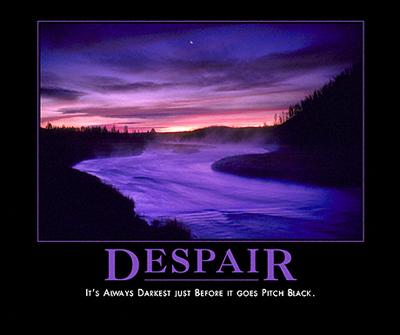

I strongly advise against this path, solely on the grounds that it sucks.
Despair, profound or silent, occurs when a person accepts that they're hungers are in vain.  And they're not too far off.  If you ever get so curious, bored, or saintly to read Ecclesiastes, you discover very quickly that the pleasures of the world, in and of themselves, are vanity and uselessness.  If you're not a Biblical type (yet), read Jean-Paul Sartre, who recognized that humanity in a Godless universe are damned to be free, damned to pursue goodness, truth, and beauty only to find it vain and purposeless.  Despair can be daunting or it can be silent, it might eat at the soul and keep you up at night, or you may never notice it apart from the ever so subtle feeling of uneasiness, of discomfort, of dissatisfaction.  You might be reading this thinking, "I'm happy and I'm not hopeful" but the fact you feel the need to reassure yourself betrays yourself.  You're not happy.  Not yet.  Otherwise, you would even bother the thought of defending yourself.  No, the whole world is, knowingly or not, in a sort of despair.

Just as light is brightest in complete darkness, so hope is boldest in a despairing world.  Hope rejects despair with bravado.  Hope looks at the world, not with despair and sadness, but with anticipation.  Romans 8:22 puts it beautifully: "We know that the whole creation has been groaning as in the pains of childbirth right up to the present time."  Hope sees a world saturated with goodness, truth, and beauty, and rather than seeing it as vain and useless, sees it as a signature.  The hopeful person looks at the beauty of the world around him and yearns for the beauty of the world he cannot see.  He sees the abundance of truth and longs to know all things in the life yet to come.  He treasures all the goodness he finds and seeks perfect goodness in a place no eyes have seen.  Hope defies vanity and serves as a kick in the pants for a disparaging world.  Hope is annoying to the hopeless, because it dares, it goads, the demands.  Hope urges where nothing else could.  Hope fights.  Too many people treat hope like a warm and fluffy cat on their lap rather than the ferocious lion that it is.  I take comfort in being hopeful, but not in a restful sense.  Hope comforts me because it beckons me not to rest until I've conquered, until I've endured, until I've found my victory.  I will rest when I do not have to hope any more.

Hope, like Aragorn, is ready to kick
some @$$.


Christians, be hopeful.  You are not a sedentary, you are active.  You have toppled empires and uprooted kings.  You have defied armies and parliaments, persecution and destruction, defamation and degradation.  Your fathers lived and died for their faith, the Faith you now carry in your heart.  Do not let your soul rest yet, because you still have a journey ahead of you.  You're not home yet.  Hope!

Saturday, May 26, 2012

On Being Human: A Guide for Christians who are doing Christianity Badly


Mothers would willingly
sacrifice their children
 to him to receive happiness
and prosperity.  Any similarities
to Planned Parenthood are
suspiciously coincidental..
Walking out of Mass one day, I had a person come up to me for a friendly conversation, and, as happens with many conversations I have after Mass, the situation of the world around us quickly became the subject.  In an exasperated tone, my friend said, "The world... it's just becoming so pagan!"  Now, I know exactly what she meant, but for conversation's sake, I replied, "If only it were so! The pagans may not have known Christ, but they certainly knew themselves.  Read works of Greeks and Romans, look at their art, listen to their stories, study their virtues, and you'll find that, while they may have been crude, they may have been barbaric, they were very much aware of what it meant to be human.  There were many flaws about pagan culture (ever hear of a dude named Moloch? (pictured right)  Wikipedia it.), many of which we've retained.  However, there were many redeeming qualities to paganism, which we've eliminated outright, things like courage, honor, wisdom, loyalty, and family.

While we may look at the pagan world, with its bloody battles, seemingly barbaric behavior, and despotic, patriarchal leadership and be disgusted, but we must not also realized that they were very serious men (and women).  When they celebrated, they celebrated with purpose.  When they fought, they fought because they had something worth fighting for.  In their vice and in their virtue, in their gaiety and their gravity, in their lives and their loves, they were very serious people.

Friday, May 25, 2012

On the Value of the Family


If ever you've wanted a bird's eye view of our culture, please, turn on the television and just start scrolling through the channels.  Each and every one of them reflects some aspect of our culture, and I'd be willing to bet that within all of about 20 seconds of scrolling, you'll come across a sitcom about a family of some sort, usually mildly dysfunctional, with a loving mother, idiot father, 3-4 children, suburban neighborhood, a distinctive neighbor for comic relief, and a trusty bar that gets visited at least twice per episode.

See what I mean?

Families are important to our society, sociologists tell us they are the basic cell of social living.  Despite what some conservative folks might say, everyone, even liberals, has family values.  Having some sort of family is part of being human, and everyone has some sort of idea of what a family ought to be (i.e., a "family value").  The difference between most "conservative" types and "liberal" types is that conservative tend to have more defined family values, while liberals (as they are in almost every circumstance) tend to leave it open for interpretation.  And there's a certain wisdom to be open-minded.  You can't eat without an open mouth, and you can't think without an open mind.  However, you'll find eating rather difficult if you never close your mouth, and thinking will be very unsatisfactory if you never close your mind around something.  Enter the family.  
For whatever reason, I find these stickers abominable.
The genius of the family is that it is the the only close companionship you don't get to choose.  In all the intimate friendships and encounters you'll experience in life, family is the only one that you have no choice in.  You don't get to choose who you're related to (spouses withholding).  In the family, you're forced to deal with people whose relationship to you is completely out of your control.  You're forced to be with people who you may or may not like, and the result is rather astounding.  You see, I think we take the sheer marvel of the family for granted.  Our families, often the most meaningful relationships we have, are forced on us.  When people lie on their death bed, they rarely say "I wish I would have been a more active member of the work community" or "I wish I would've done more the Knights of Columbus."  And not that there's anything wrong with work or the Knights of Columbus, but in many a dying breath, a person will call out for their family.  Our most beloved relationships, our greatest motivation, and the deepest affections of the heart are almost always the family.

Why is it that our families, our one significant captive relationship, inspires such deep love?  Well, because love and captivity go well together.  Love is a captivating force.  Within its very essence, it disregards safety and comfort in favor of vulnerability and captivity.  Humanity, as much as we like to think otherwise, loves to subjugate ourselves.  In the movie The Avengers (which, sadly, I've yet to see), Loki (evil God-like figure, taken from Norse mythology) gives a fascinating speech in Germany: 

Diabolically evil or not,
he's got a point.
"Kneel before me.  I said... KNEEL!  Is not this simpler? Is this not your natural state? It's the unspoken truth of humanity that you crave subjugation.  The bright lure of freedom diminishes your life's joy in a mad scramble for power.  For identity.  You were made to be ruled.  In the end, you will always kneel."

Traitorous as it may be, I'm actually with the super-villain on this one. (Granted, I'm not a huge fan of the whole idea of forcing servitude upon us...) As much as we love freedom and all the shiny things that come with it, we want even more to bow.  Long before man ever constructed ballot boxes and free market economies, he built temples, hierarchies, and, most of all, families.   The family is living breathing testimony that subservience and love go hand in hand.  It shows us that the best relationships come when we put aside our preferences, agendas, and egos, and be with the other.  

In the family, our proximity to each other demands our consideration of each other.  Because I have to live with you, I also have to consider you as a person just like me.  Even more so, we have to regard them as equal, which, if you're like me and don't always like or agree with your family members, is incredibly difficult.  I can go to London, Rome, or New Delhi and walk around people who are vastly different than me, but it is not nearly as adventurous or as taxing as trying to relate to the people I'm related to.  I might sit and study the Brits, Italians, or Indians, in all their differences from me, but I never am forced to deal with them in the way I'm forced to deal with my sister at 6:30 in the morning fighting for a shower.  I might be the most interesting man in the world, but I'm still equal to my family around the dinner table.  I still have to subjugate myself, to contain myself, to curb my own freedom for the sake of another.  As paradoxical as it sounds, my family is most beloved to me because it is most forceful upon me.  Because I'm captive in my own family, I love my family.  Because I have to deal with them, I love them very much.  In the subservience that results from the brilliant intersection of forced cohesion and personal differences, I discover my own capacity to truly, deeply love others, in a way that surpasses every other aspect of life.

You'd be hard-pressed to find something more marvelous than the family. Even though it may be held in four walls, it can be more adventurous, require more courage, more sacrifice, more exhaustion than a journey up Everest or into the Amazonian wilderness.  There's a good reason why there's so much focus and debate around the family these days:  The family is superhuman.  In the Trinity, we see God's nature as a family:  Father, Son, and Holy Spirit.  Christ's first experiences of being a human were in a family.  Family is carved deep into the very heart of humanity.  We debate and fight about family because family is one of the few things worth debating and fighting over.  I'm not telling you which side to fight for, although it's rather obvious where I'll stand on this issue, but for God's sake, make sure you understand the gravity of this ancient idea we call family.

Wednesday, May 23, 2012

YOLO, Click, and the Simple Secret to a Happy Life

You only live once.  Hate to admit it, but for once, a rap song was right.  Actually, there's a lot more truth to rap songs than most people know, but usually its buried amidst an army of emotionally charged words about less-than-thought-out actions.  But I digress...

"I have had it with the @#$#$^#$%# YOLO
on this @#$@#$@#%@ interwebs."
It's true, however, what Drake and Tyga said.  You do only live once.  Death happens to the most certain and most grim reality for us.  Therefore, it must be asked:  What do I do in this one life that I have?  In a life that ticks ever closer towards the unknown, what do we do with it?

Now, I'm in full understanding of the typical usage of the phrase "YOLO." It usually goes with person A doing something potentially hazardous, risky, or otherwise unknown, and person B applying steady peer pressure with the ever encouraging "Come on bro, YOLO!"  In the modern context, especially in regards to young folks like myself, we tend to associate the brevity of life with the need to experience as much as possible, to hell with the risks.  To boil down an otherwise complex philosophical concept to an indiscriminate cliche, our treatment of YOLO is essentially the idea that the unbridled achievement of your desires will ultimately make you happy.  Unfortunately, there's a minor problem with this notion: IT DOESN'T @!#!!@#$! WORK!

Universe-controlling remote...
Sounds like a future product
 line for Apple.
Perhaps that's the greatest lie we've ever excepted as a society:  That after all our desires have been fulfilled, then can we reflect upon our lives in satisfaction.  After I've been able to have everything I want to have, be everything I want to be, do everything I want to do, and live the life I want to live, then I'll be truly happy.  After I've gathered to myself all the wealth, honor, pleasure, and power I possibly can, then I'll be happy.  Unfortunately, it doesn't work.  Unfortunately, the man who has everything he ever wanted will no longer want everything he has, he'll only search for that which he does not have.

 There's no surer path to misery than the self-made life.  The person who has crafted his life himself is assuredly the most unhappy person.  They have made a universe small enough to fit in their head, they have eliminated all wonder in their life in favor of control, and have thus failed to see even the greatest things as wonderful.  Take, for example, the Adam Sandler movie "Click."  It came out in 2006, had bad reviews, involved a remote.  Remember it?  In the story, Sandler plays a workaholic architect always climbing the corporate ladder and ignoring anything that could get in his way.  Then, by chance, he meets a man named Morty who gives him a remote with which he can control his life, most prominently through time.  He later finds himself fast forwarding himself through larger chunks of time and missing out on more and more of his own life, costing him a marriage, a relationship with his children, and, in a tearful scene, (or, at least it was for me.  Don't judge.) his life.

What does he learn?  In an "Its A Wonderful Life" -esque journey, he realizes that, while he had absolute control over his life, he missed the whole point.  He did become wealthy, powerful, and important, he lost everything in the pursuit.  The Biblical wisdom played true:  he paid for the world with his soul, and found that, while collapsed on a hospital parking lot, dying in the pouring rain, that it wasn't worth anything at all.

A reckless life, while fun, is rarely happy.  Now I'm certainly not arguing against the value of good ole-fashioned fun, or having an enjoyable life.  The last thing I want to see is a world of somber people.  But I just as much do not wish to see a world full of flippant people.  Fun, enjoyment, and life ought to be taken seriously.  We ought to take pleasure very seriously, lest it lose its fun-ness (Not a word, I know, but are you really going to punish me for my creativity?).  Yes, we do only have one life.  Spend it wisely.  Do not seek after wealth, honor, power, or pleasure.  They'll find you in due time and in proper degree.
He's got a point there...

A happy life (if you believe in happiness) is really a simple matter:  As Epicurus puts it: "Not what we have, but what we enjoy, constitutes our abundance."  Do not seek for more, enjoy what you have.  Adam Sandler's character used his control over life to seek what he wanted, and dying on the pavement, he looks up at his family and realizes that he has had everything he ever wanted in the first place.

We have quite a marvelous world, made by an infinitely more marvelous God.  Rather than creating a life and a world for ourselves, which will inevitably end in dust and ash, live life in the world God created for you.

Thursday, May 17, 2012

How To Properly Be Intolerant

In my last post on intolerance, I discussed much as to why being intolerant is perfectly okay, but, as a few readers pointed out, this can lead to all sorts of mayhem if it gets into the wrong hands.

See what I mean?
So, it is only just and right to explain further the proper ethic of being intolerant...

Tuesday, May 15, 2012

I Am Not Tolerant

Yes, you read that right.  I am not not tolerant.  I am intolerant.  A bigot, by the definition of some.  And quite honestly, I'm perfectly fine with being intolerant.  Why?  Well for one, because no one has ever actually made a good case for being universally tolerant.  Allow me to explain:


Ever seen one of these coexist bumper stickers?  They're quite rampant on the bumpers of young, progressive-minded people, and represent a general ethos that drives the moral attitude of the modern age: tolerance.  I understand the intention behind the advocates of tolerance.  They want us to appreciate everyone else, to understand and recognize the differences of other people without prejudice.  And there's nothing wrong with that.  There is, however, something very wrong with being tolerant (or at least in the sense that most people have taken it).  At first glance, there are many desirable traits about being tolerant, namely the fact that it prevents everyone from breaking down into bloody conflict.  However, after that, it seems the benefit seem to run thing.  While being tolerant of might prevent me from shooting my neighbor, it will also inevitably prevent me from disagreeing with him, and that is deplorable.

Tolerance's biggest problem is that its biggest enemy is conflict.  To a person who is preaching tolerance, the worse possible sin is conflict, usually a conflict that results in some form of suppression or oppression. However, conflict is not man's greatest sin.  Rather, the capacity for conflict is man's one redeeming quality.  The fact that man can fight shows that he has something worth fighting for.  By denying him the ability to fight, you deny him the value of those things which he fights for.  Yeah, you might prevent person A from stabbing person B, but you inadvertently prevent them from recognizing that they have something worth fighting for.  By telling the Christian and the Muslim that their religions are only subjectively valuable and have no objective value, you insult both people by taking away the dignity of  both faiths.
Oh the irony...

Its good to fight.  I'll say it again, it's good to fight.  No, its not good to kill, nor is it good to be hateful, or harmful, but by God, it's good to fight.  G.K. Chesterton once said, "A good soldier fights not because he hates what's in front of him, but because he loves what's behind him."  We have to fight, not because we hate, but because we love.  Conflict has to erupt in our lives, conflict with others, and even conflict within ourselves.  We have to love something, someone, and we have to love them with enough ferocity to fight off the universe if we have to.  Why?  Because that's what we were made for.  We were made to love, and if we are truly going to love, then we're truly going to fight for that love.

Thus, I'm intolerant, not because I hate, but because I love.  I love Truth, I love Justice, I love virtue, and most of all, I love Jesus Christ.  Therefore, I can't be tolerant.  I can (and will) be charitable, merciful, and kind, but by God, I will not be tolerant.  I will fight for what I love, because there are things worth fighting for.  You can call me intolerant, but you'll never be able to call me apathetic.


Monday, May 14, 2012

Consumer Religion

"I used to be Catholic, but I left because it didn't suit me"  
"I used to go the Catholic Church, but I wasn't being spiritually fed"  
"I go to the [insert name of hip young modern church] because they understand me, I really get something out of it."

Ever heard these lines?  Or perhaps, you're one who has said these lines when someone asks you why you switched churches.  I'll be blunt, I have an issue with these lines, and indeed, with the logic behind them.  While I understand that people are searching for spiritual fulfillment, I can't help but think they're doing it entirely wrong. Now, I know what people are looking for, and there's nothing wrong with looking for spiritual fulfillment.  However, what is wrong is the method with which they search.  You see, there seems to be a spiritual epidemic of people migrating from church to church in search of the church that suits them, and more often than not, it reflects a person's hunt for a favorite restaurant rather than a genuine pursuit of truth.  
 
Our culture has, since the early to mid 20th century, had a massive tone of consumerism.  The notion of consumerism places a strong emphasis on option, on choice, on the ability to pick the life you want to live, and has resulted in nearly unlimited ability for individual expression.  This attitude of consumerism has benefits, but it also have deficits.  However, among one of it most unique qualities it has is its near parasitic ability to spread into every aspect of life.  For many in our culture, its not good enough to have choice in economics, we must also have choice in education, choice in our personal lives, and, most alarmingly, choice in our religious faith.  

Now I'm not talking about freedom of religion in the political sense.  I'm all for people being able to choose their faith.  However, I'm not okay with people being able to do so inconsequentially. Its alarming that people can move from church to church, teaching to teaching, doctrine to doctrine, not with objective truth as the object of their search, but personal preference.  The biggest deciding factor in many people's faith journey isn't whether the teachings and practices of the faith reflect and speak to the Truth, but whether the teachings and practices of the faith reflect and speak to the self.  They want engaging, touching religion more then they want true religion.

"But Joe, what's wrong with a faith that speaks to one's self?"  Great question, disembodied skeptic!  It might seem preferable to have a faith that speaks to the person, that engages the person, that appeals to them.  However, as fun and exciting as it is, it doesn't base the faith around God. Instead, its based around personal preference, which often has nothing to do with God.  For example, if I have to take a trip to Timbuktu, the path I take better end up getting me there, whether I like it or not.  It's certainly nice if the trip starts where I am at, and takes into my account personal preferences, but if it doesn't actually get me there, its purposeless.  

This is the sad effect of church hopping modern progressive Christianity:  ultimately, its all about me.  My likes, my dislikes, my preferences, my this, my that, me, me, me, me, me!  Faith is never meant to be about me, its meant to be about God.  Too often we leave a Church saying "I didn't feel God" when honestly, its not about feelings at all.  We're not meant to feel close to God, we're meant to BE close to God.  We can't be consumer religious.  Many people say that we shouldn't be a consumer society, because we end up being that which is consumed.  I say we shouldn't be consumer religious, precisely because religion is supposed to consume us, and not vice versa.