Tuesday, June 12, 2012

Rethinking Catholic Identity

But... Why?  What purpose could such a contraption serve?

Ever since the Second Vatican Council, The Church has seen the phrase "Catholic identity" enter it's lexicon in increasing extent.  I go to a Catholic university, and we are dripping with that phrase.  "We need more Catholic identity here" and "Catholic identity needs to improve" and "This campus has a weak Catholic identity" and so on.  We drop the phrase like its nothing, and I wonder if we actually stop to ask ourselves "What does it mean to be Catholic?  What is our Catholic identity?" because all too often, it is the words we use the most that we know the least about.

First off, he never actually said that.
Second, the presence or absence of this mug
in your possessions makes you no
 more or less Catholic.

All too often, I find that when people use the term "Catholic identity", they really mean "Catholic brand".  They want their university/high school/hospital/youth ministry/indoor and outdoor decor to look Catholic, usually to an overwhelming extent.  In the same manner that a guy might make his man-cave a glittering tribute to Budweiser, Dale Earnhardt Jr., and Goodwrench tools, he could make it a glittering man-cave dedicated to Mary, St. Francis, and Padre Pio.  Now, its perfectly good and holy to have great devotion to these people, but true Catholic devotion differs in style from a devotion to beer, NASCAR, and tools.  People know our devotion to a certain brand or icon because we put its image on our person and property (or, in the case of one guy who passed away, on his tombstone.  Busch Light cans, sandblasted in stone until the end of time.)  Catholicism is not a brand.  We're not one marketing scheme among others, nor are we one purchase among others in the religious marketplace.  Catholicism isn't one option of religion among others, as much as our society (and many Catholics) seem to think.

All religion is Catholic, Catholicism is all religion, because, as St. Justin Martyr said, "Everything that is true is ours."  We're not one option among others.  We're not even the best option.  We, the Catholic Church, are the only option, apart from the nihilistic option to have no option whatsoever.  If, by any chance, you grasp onto some sort of Goodness, Truth, or Beauty, you're grasping towards Catholicism, whether you realize it or not.  When you progress towards anything except for nothing at all, you progress towards Catholicism.  People think of religion as a series of different camps or schools, when it is really only one camp, and the only difference between religions is how far into the camp you're willing to travel.  Think of it as a hill.  Many will say "I stand on the hill of Islam, or Buddhism, or Atheism, or Deism, or Catholicism."  When really, there's one mountain, with the glittering cathedrals of Catholicism perched upon its lofty slopes, and the only thing distinguishing my faith from yours is from where you approach the mountain, and how far up it you choose to climb.  Perched on the peak, shining brighter than the sun, is Jesus Christ.  All truth, all goodness, and all beauty are measured in proximity to Jesus Christ, and inseparable from Christ, by right of Divine Marriage, is the Church.  Catholicism isn't an option or brand as much as it is a journey to Truth; Catholic identity isn't differentiating yourself as Catholic rather than anything else as much it is merely seeking to be the best possible.
 
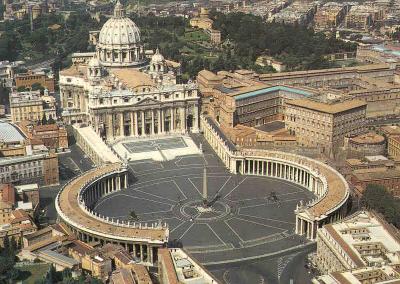
As it turns out, the Vatican actually is a city on a hill...
When we seek to have a "Catholic identity" we cannot treat it as some marketing scheme for our religion as opposed to another religion.  Display your symbols if you must, but not because its cool, or trendy, or you want to others to know what brand you've bought into.  Catholicism must not be reduced to the religious version of a North Face jacket.  We're not a religion of trendy slogans and bumper stickers, each more clever and witty than the last.  We're the fullness of Truth on this side of eternity.  If you wish to identify as Catholic, identify as all that is good and true and beautiful in this world.  Catholicism is the mountain of the Lord, the City perched on the Hill, and our so-called "Catholic identity" resides upon the extent to which we climb that mountain.  As Blessed Pier Giorgio Frassati often said, "Versa l'alto!" (Towards the top!)


Monday, June 11, 2012

Let's Talk About Sex Again

Because the awkward is never quite awkward enough for me...

Recently, I was directed to read an interesting article on RELEVANT magazine's website.  For those of you too lazy to read the article, I'll be kind enough to summarize.  Essentially, the article points out how studies have shown that 88% of unmarried young adults (ages 18-29) are having sex.  For Evangelicals in those categories, the numbers are not much different, coming in at 80%.  The rest of the article elaborates on the reasons abstinence is failing, and what Christians must do to address these issues, etc. etc.  Read it if your bored (and lets be honest, if you're reading this blog, you're pretty freaking bored.)


This article lead me to wonder "Why is our conversation on sex not working?" and its lead me to a rather simple conclusion:  We're not having one.  More often than not, the conversation isn't a conversation, its a lecture.  And a pitiable one at that.  Many critics and skeptics always love to point out the failures of abstinence-only education, and its no wonder why.  More often than not, when we tell a teen to be abstinent, it comes in the form of telling them what not to do (i.e. sex).  But then we never actually tell them what their supposed to do apart from not doing what their not supposed to do.  Our discussions on sex end up looking like the creepy gym teacher from "Mean Girls".   Or, if we're half-hearted about it, we'll bring in these hyped-up, high energy chastity speakers.  They'll wear a cool graphic t-shirt (usually vintage-esque, either of a rock band or brand of soft drink) and try their darnedest to look just like your average high-school student, to talk like your average high school student, to act like your average high school student, because that's exactly what you'll do if you're a good salesperson, you try to convince your audience that you are just like them in every way except you have the Product, which, in this case, happens to be a hyped-up presentation on why you ought not to have sex.

Now, I'm not trying to bash on the Christopher Wests and Jason/Crystalina Everts of the world, by all means, they're doing a good thing. On many people, this works.  It worked for me, I got the message, listened to the facts, bought into the message, and I'm all the happier for it.  However, according to RELEVANT's study, 88% of the kids aren't buying it.  They see the chastity speakers, or worse, the creepy sex ed teachers, and completely ignore them.  They know, despite the best efforts and the cool vintage "Orange Crush" t-shirt, that the chastity speaker is not a teenager, and thus is absolutely incapable of understanding the life and times of the modern teenager.  The chastity speaker (or the poor, lonely, government funded sex-ed teacher, while engaging, funny, well-informed, and good-intentioned, operates in a void if he/she isn't reinforced.  They'll always be wrote off as out of touch, or ignorant, or prudish.  In the eyes of a teenager, no matter how convincing, or hip, or enthusiastic, or statistically supported a sex educator is, he's nothing more than a sex educator, a thing rather than a person.  And teenagers, like most people, really don't care what things have to say, they only care to hear what people have to say.

When we talk about sex, we actually need to talk about sex.  People don't abandon abstinence because Jason Evert just wasn't cool enough, they abandon abstinence because, despite Jason Evert's best efforts, they just don't believe abstinence can work.  Sure, you can abstain from sex until marriage, but you also can sprinkle broken glass in your socks each morning.  But walking with glass shards in your feet is not fun, and nor is missing out on all the fun your sexually-active peers are having.  And, they look, act, and talk just like all your clearly exemplary MTV role models.  Nobody's going to be abstinent if abstinence is a miserably fearful life, and our current efforts make it seem so.  Speakers will quote statistics and studies until their blue in the face, but statistics don't have faces.  However, JWoww does.  And its a smiling face, and its a very, very sexy face.  Much more sexy than Suzy Prays-A-Lot over there.  Point is, without actually talking about abstinence, without showing that it actually works and that you can be happy being abstinent, Jason Evert and Christopher West are wasting their time.  I love them to death, but nobody's message is going to get across if the audience is convinced that it's irrelevant.

So, if I haven't lost you, or infuriated you for throwing the patron saints of chastity speakers under the bus, you ask "How do we go about this sex education business then, O Cheeky One?"

Well, for starters, we need to stop treating sex like a taboo we're reluctant to address.  The general consensus regarding sex seems to be that it's naughty, dirty, and secretive.  Seriously, when was the last time you ever had a serious conversation with someone about sex and not feel a bit awkward or dirty for doing so?  Our society, ever so awkward, has done a might impressive job of shoving overt sexuality down our throat, but has been absolutely mum to speak about sex with any sort of sincerity.  In an epic irony, the most overtly obvious subject of society seems to be the one its most ashamed of.  If we're ever going to seriously talk sex, we need to seriously talk sex.  No more dirty little secrets, no more naughty stigma.

I can almost hear the choruses of people protesting that notion, primarily on the grounds that there are inappropriate times to discuss sexuality and removing the stigma would let our sweet little schoolchildren run around rampantly, talking about sex.  While I agree, there are times that discussing sex isn't appropriate, that doesn't excuse the stigmatization of sex.  It's inappropriate to get in a fight at your grandmother's funeral, but that doesn't mean it has to be something secretive or dirty.  Additionally on that note, inappropriate or not, teens and young adults are confronting their sexuality, and making them feel shameful about it ain't solving a thing.  Rather, we ought to de-stigmatize sex, to give it its time and place.  Honestly, at the risk of infuriating pretty much everyone reading this, we ought to take a hint from Planned Parenthood.  Now, hear me out first, before you search me out to tar and feather me.  Planned Parenthood is screwed up in their understanding of human sexuality to the umpteenth power, and I wouldn't touch their ideology with a 39 and a half foot pole, but they're not afraid to talk about sex.  Granted, they mostly talk about sex the way a blind man talks about driving a car, but they do talk.  Most Catholics seem to be too afraid to address the subject outside of the comfort of their pamphlets and dog-eared copy of Theology of the Body for Beginners (if even that).  When a kid comes to Planned Parenthood with questions of sexuality, they'll get conversation, and they'll get answers.  Bad answers, but answers nonetheless.  The most that can be expected from a youth questioning a Catholic (or most other Christians for that matter) on sexuality is to have a purity ring and carefully rehearsed verses thrown at them.

Which leads me to my next point.  Kill the cliches.  They're nice, they're convenient, but they don't actually do anything.  Our current models of sex education are based around facts, figures, and well-versed theological discourse (usually condensed into a super-lite kid friendly version.)  When boiled down, most abstinence presentations boil down to "Don't have sex until marriage, because if you do, you're __% likely to get (insert any combination of STD's), __% likely to get pregnant before marriage, which makes you __% likely to live in squalor until you're __ years old.  Oh, and God intended sex for marriage and you'll be happier that way and you'll get your reward in heaven."  Gee... thanks.  That'll really help the next time a Victoria's Secret commercial shows up on T.V.  All snarkiness aside, chastity is a battle between passion and principle, and if we're going to send our youth out to fight it, one high energy bomb of information, while immensely helpful, won't win the battle.

We need parents and guardians to have the courage to honestly and sincerely address sexuality.  Rather than hide the subject, or dodge it, or inadvertently reinforce the shame and stigma that their child might connect to sexuality, parents need to be courageous and compassionate enough to talk about sex.  Not as something dirty, or shameful, or secretive, but as an honest, natural, and dignified aspect of human nature.  Sex ought to reflect the best in us.  It ought to reflect our capacity to love, to surrender to an experience of beauty, to create new life.  Sexuality ought to reflect the best of what it means to be human, not the worst.  Parents need to rethink sex education and be courageous enough to take a role in their kid's maturing.  Teach them what it means to be a human being, or better yet, show them.  Show them that sexuality isn't just genitals and where you want to put them.  Its a matter of the soul.

Sex isn't merely physical, its profoundly spiritual.  Sex reflects, in unbridled passion I know not, the passionate love of the soul.  Sex is good, sex is beautiful, sex is holy.  You'll never find a bad word to describe sex, but you'll find a million to describe sex done badly.  We need sex, if not for procreation than for beauty.  We need to experience the passionate power of love, to understand it not just as something abstract, but as something so very real.  We need to know what love is, true love, and how it transforms us.  We need to know how it makes us husband and wife one.  Our culture has corrupted sex, and so sex must work to redeem the culture.

Our youth (I'm one of them) have a hell of a lot of questions and no one with the gall to give a serious answer to them.  We're sick and tired of insufficient answers, and we sure as hell don't want to get cheated of the truth.  So he're my plea to the Church:  show us.  Please, don't let questions go without answers, or the stories to go untold.  Teach us what it means to be man and woman and everything that comes with it.  We can never be saints without it.  We want to have sexual integrity, we NEED to have sexual integrity.  Let this be a wake up call to the Church (and to myself): Let's save sex.  Our most beautiful gift of sexuality is under assault by those who'd give it to swine and slop.  We need to save it, because without it we have no hope of being saved.


Sexual redemption:  Like the Crusades,
only less blood and genocide.

So redeem sex!  Reclaim sex from a society that's done a deplorable job maintaining it.  Reclaim it because it is ours.  Just like all good things, sex belongs to God, and only when oriented unto God do we find its treasures.  We have a tired and bored culture, one of cheap thrills and exhausted people, they will say that I'm idealistic at best, idiotic at worst.  Whether these accusations are true, time will tell.  However, you cannot deny me this:  I'm bold.  Not just for talking about sex, if that were the case, then a young man's bravest moments would be in the locker room.  No, I'm bold because I am willing to be idealistic.  Yes, it may be practical to hand out condoms to youth and young adults, but it certainly isn't courageous.  Our sexually dysfunctional culture and those who speak for it may say that abstinence is a pipe dream, and that sex is inevitable.  Besides offering up myself and the many others like me who have managed to remain abstinent, and even offering up those who wish they would've, I say this:  No great man achieved by being a coward.  Martin Luther King Jr. never said, "I have a carefully thought out and practical plan of action, complete with a thorough bevy of options."  He had a dream, and by God, that dream is becoming a reality each and every day.  Abstinence can work, abstinence will work, because abstinence has worked.  We are not slaves to our flesh, and we can and will learn, through hard work and discipline like the sinners and the saints before us, how to be holy again.
Wednesday, June 6, 2012

Literal (or A Brief Explanation of the Eucharist)


"Joe, we don't really, literally, believe that the Eucharist is the Body and Blood of Christ.  I mean, if I smuggled a host away from Mass one day, gave it to a team of top notch scientists to analyze in a lab, they're going to see bread in their microscopes and in their analyzers.  Bread, not flesh or blood.  So it can't literally be Jesus's body, it's only symbolic.  Right?"

This lovely question came to me from a good friend who found the notion of the Eucharist rather fascinating.  I gave him a brief explanation of the metaphysics of the Eucharist, but he asked for me to blog about it.  Probably so he can refer to it, reference it, etc. etc.  So here's your post, you who know who you are:

Friday, June 1, 2012

On Being Passionate


If you asked me what I thought was the biggest problem of our modern age is, I wouldn't say abortion.  I wouldn't say a culture of death, or the HHS mandate, or sexual immorality, or liberal theology, or the impending zombie apocalypse.  No, while all of these things are concerning to various degrees, the biggest problem of our modern age is the lack of true passion.  With the rise of skepticism, the notion that doubt is the greatest form of criticism and that belief is the greatest form of weakness, we've begun to erase any sort of true passion in our lives.  We have affections, we even have obsessions, but passions?  We're nearly bone dry.


Passion, unlike obsession or affection, is challenging.  Its easy to have affection towards something.  Its easy to become obsessed with something.  But to become passionate?  Such a thing is difficult.  Why?  Because passion requires sacrifice.  Passion requires effort.  Passion requires discipline and dedication.  Most of all, passion requires devotion, and devotion is a dead.  In a culture in which freedom, as the Supreme Court defined in the Casey v. Planned Parenthood case, "...is the right to define one's own concept of existence, of meaning, of the universe, and of the mystery of human life," being devout is very near impossible.  We love to make gods of ourselves, to tout our own freedom, to place the universe in our pockets and claim it for our own.  We take on the world with sword in hand until we get a triumphant breath and realize that being God is so very lonely.  We'll climb the highest heights, we'll stand on the summit of Everest and think ourselves giants, and realize that this world wasn't created for giants, it was created for men.  And men are devout.   Men believe.  They look for goodness, truth, and beauty and believe in it, they dedicate themselves to it.  Gods, however, craft their own definitions for goodness, truth, and beauty.  They say "What's good for you isn't good for me, what's true varies from person to person, culture to culture, era to era, and beauty lies only in the eye of the beholder."  They mean to create a world in which everything is good, true, and beautiful, and instead they create one where nothing is.  They discover, much to their chagrin and dismay, that they grasped once again at the fruit and thus fell from Eden.  No, a man cannot make himself into a God, lest he quickly discover that he lacks God's power to create and only retains the power to destroy.  


Men must be devout.  They must submit, the must find the greatest of all things and kneel before it, the must adore it.  If we are ever to enjoy the world, if our hunger for unfading joy is ever to be filled, we cannot set ourselves above the transcendent values of the world.  No man forces beauty, nor does he control goodness, nor can he create truth.  He can only recognize these things, and in the act of doing so, devoutly submit himself to them.

After devotion comes dedication and discipline.  Devotion, though it is wholly natural, is not wholly easy.  It requires discipline.  If I am to love goodness, truth, and beauty, that is, if I am to truly value the world around me, I must be changed by it.  If I admire goodness, I must become good.  If I seek truth, I must become more true.  If I sigh in awesome admiration of beauty, I must become more beautiful.  Devotion leads to discipline, to a change in myself.  Discipline forms people, it molds them and changes them.  It humiliates and disintegrates people, but only that they might be exalted and have integrity.  Like clay on the potters wheel, discipline molds potential into actual, clay into vessels, men into saints.

Through discipline comes sacrifice.  All great loves, all true devotions, all worthy disciplines require sacrifice.   The process of submission, of humbling oneself before the beloved is painful, because it strikes a direct blow to enemies within us.  Sacrifice is a battle, a battle of the scale of St. George and the Dragon, because in sacrifice, we fight ourselves.  Our temptations face our aspirations, our virtues battle our vices, our loves face our fears.  Sacrifice is the battle for our soul, for our very heart.  Only through sacrifice do we strike a blow upon our worst enemy:  ourselves.

This is passion:  Devout, disciplined sacrifice.  Passion should be invigorating and exhausting all at once.  It should empty us, and because we're so empty, we're full.  Paradoxical?  (enter obligatory Chesterton quote) "The riddles of God are more satisfying than the solutions of man."  Passion is more than strong feelings.  Its more than affection or obsession, its sacrificial.  There's a reason why we call the suffering, death, and Resurrection of Jesus Christ his Passion.  The Cross of Jesus Christ is the most sublime of all examples of passion, for in it, he demonstrates absolute sacrifice, discipline, and devotion.


We need passionate people, especially Christians.  We desperately need people to rediscover devotion.  We need to stop taming religion.  We've created a religious climate that looks less like Calvary and more like a group therapy session, and its proving to be a sorry failure.  People want to kneel at the cross of Jesus Christ.  The Cross is the junction of human existence, it is the pinnacle of what it means to be human and the signature of God's relentless love.  Here lies the root of true passion.  Every passionate longing of the human heart is both fulfilled and ignited from the Passion of Jesus Christ.  If it is capable for you to feel passion, for you to love, it is because of the love and the Passion on the Cross.

Be passionate people.  Find your devotion, make sure it is worthy.  Discipline yourself in it, make the necessary sacrifices for it, and discover your passion for it.  Find something good and be good.  Discover the truth and be true.  Delight in beauty and become beautiful.  The human heart is not meant to be dull and tame.  It is an organ of true passion, of disciplined devotion, chiseled in sacrifice.  Be passionate!


Tuesday, May 29, 2012

On Hope


"Be filled with Hope: Jesus Christ is always victorious!" -Blessed Pope John Paul II

Christianity is an audacious assertion.  If you want to learn this lesson most sublimely, listen not to her advocates but to her critics.  Everywhere you turn you'll find people mocking, ridiculing, and all around belittling Christianity in anyway possible.  You'll find people marginalizing it, abstracting it, diagnosing it, disregarding it, and detesting it.  Critics will psychoanalyze, evaluate, speculate, and demonstrate; anything will be done, short of serious consideration, in hopes of quelling the audacity of Christianity.  Taken with its full brunt, Christianity is earth-shattering, it rewrites the foundations of the Universe itself, there isn't anything in the heavens or on the earth not utterly revolutionized by Christianity, and our critics know this better than we do.  We treat Christianity like any old warm blanket, they treat it like a terrifyingly and bizarre army.

Hope is the urge that drives you to ride in the face of all things.
And perhaps, among all the audacities of Christianity, one of the boldest and most necessary is hope.  Hope can be sentimentalized, yes, but hope is not sentimental.  Hope is brutal.  Hope is absurd.  Hope, in and of itself, is paradoxical.  "Hope," says Chesterton, "is hoping in that which is hopeless, else it is no virtue at all."  If I were to hate Christians, I would hate them for no reason other than their hope.  Hope would set aside even the greatest of worldly goods for even more.  If I were to hate Christianity, its because the Christian alive with hope would never have it well enough: he would always want a better, truer, and more beautiful world to live in precisely because that's what he hopes for.  His hope would fuel his unquenchable aspiration in ways the world cannot begin to understand.  Hope would not make him aloof, it would make him involved.

All human action is driven by the pursuit of three things:  goodness, truth, and beauty.  No human person will do anything unless they see some goodness, some truth, or some beauty in it.  No matter what, not even the most despicable or desolate of human actions is not done without some goodness, truth, or beauty within it.  The human soul will always desire these three things, and will desire them relentlessly.  He will hunt them, he will pursue, and he'll never be truly happy until he finds them, or rather, until they find him.  The pursuit of these great and transcendental values will lead, in its fullest sense, to one of two paths:  Despair, or Hope.


I strongly advise against this path, solely on the grounds that it sucks.
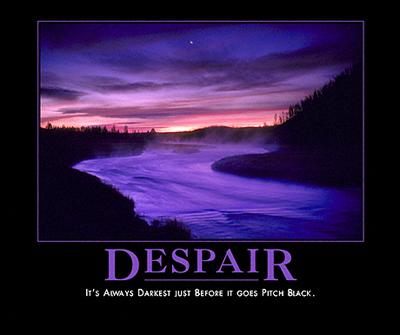
Despair, profound or silent, occurs when a person accepts that they're hungers are in vain.  And they're not too far off.  If you ever get so curious, bored, or saintly to read Ecclesiastes, you discover very quickly that the pleasures of the world, in and of themselves, are vanity and uselessness.  If you're not a Biblical type (yet), read Jean-Paul Sartre, who recognized that humanity in a Godless universe are damned to be free, damned to pursue goodness, truth, and beauty only to find it vain and purposeless.  Despair can be daunting or it can be silent, it might eat at the soul and keep you up at night, or you may never notice it apart from the ever so subtle feeling of uneasiness, of discomfort, of dissatisfaction.  You might be reading this thinking, "I'm happy and I'm not hopeful" but the fact you feel the need to reassure yourself betrays yourself.  You're not happy.  Not yet.  Otherwise, you would even bother the thought of defending yourself.  No, the whole world is, knowingly or not, in a sort of despair.

Just as light is brightest in complete darkness, so hope is boldest in a despairing world.  Hope rejects despair with bravado.  Hope looks at the world, not with despair and sadness, but with anticipation.  Romans 8:22 puts it beautifully: "We know that the whole creation has been groaning as in the pains of childbirth right up to the present time."  Hope sees a world saturated with goodness, truth, and beauty, and rather than seeing it as vain and useless, sees it as a signature.  The hopeful person looks at the beauty of the world around him and yearns for the beauty of the world he cannot see.  He sees the abundance of truth and longs to know all things in the life yet to come.  He treasures all the goodness he finds and seeks perfect goodness in a place no eyes have seen.  Hope defies vanity and serves as a kick in the pants for a disparaging world.  Hope is annoying to the hopeless, because it dares, it goads, the demands.  Hope urges where nothing else could.  Hope fights.  Too many people treat hope like a warm and fluffy cat on their lap rather than the ferocious lion that it is.  I take comfort in being hopeful, but not in a restful sense.  Hope comforts me because it beckons me not to rest until I've conquered, until I've endured, until I've found my victory.  I will rest when I do not have to hope any more.

Hope, like Aragorn, is ready to kick
some @$$.


Christians, be hopeful.  You are not a sedentary, you are active.  You have toppled empires and uprooted kings.  You have defied armies and parliaments, persecution and destruction, defamation and degradation.  Your fathers lived and died for their faith, the Faith you now carry in your heart.  Do not let your soul rest yet, because you still have a journey ahead of you.  You're not home yet.  Hope!

Saturday, May 26, 2012

On Being Human: A Guide for Christians who are doing Christianity Badly


Mothers would willingly
sacrifice their children
 to him to receive happiness
and prosperity.  Any similarities
to Planned Parenthood are
suspiciously coincidental..
Walking out of Mass one day, I had a person come up to me for a friendly conversation, and, as happens with many conversations I have after Mass, the situation of the world around us quickly became the subject.  In an exasperated tone, my friend said, "The world... it's just becoming so pagan!"  Now, I know exactly what she meant, but for conversation's sake, I replied, "If only it were so! The pagans may not have known Christ, but they certainly knew themselves.  Read works of Greeks and Romans, look at their art, listen to their stories, study their virtues, and you'll find that, while they may have been crude, they may have been barbaric, they were very much aware of what it meant to be human.  There were many flaws about pagan culture (ever hear of a dude named Moloch? (pictured right)  Wikipedia it.), many of which we've retained.  However, there were many redeeming qualities to paganism, which we've eliminated outright, things like courage, honor, wisdom, loyalty, and family.

While we may look at the pagan world, with its bloody battles, seemingly barbaric behavior, and despotic, patriarchal leadership and be disgusted, but we must not also realized that they were very serious men (and women).  When they celebrated, they celebrated with purpose.  When they fought, they fought because they had something worth fighting for.  In their vice and in their virtue, in their gaiety and their gravity, in their lives and their loves, they were very serious people.

Friday, May 25, 2012

On the Value of the Family


If ever you've wanted a bird's eye view of our culture, please, turn on the television and just start scrolling through the channels.  Each and every one of them reflects some aspect of our culture, and I'd be willing to bet that within all of about 20 seconds of scrolling, you'll come across a sitcom about a family of some sort, usually mildly dysfunctional, with a loving mother, idiot father, 3-4 children, suburban neighborhood, a distinctive neighbor for comic relief, and a trusty bar that gets visited at least twice per episode.

See what I mean?

Families are important to our society, sociologists tell us they are the basic cell of social living.  Despite what some conservative folks might say, everyone, even liberals, has family values.  Having some sort of family is part of being human, and everyone has some sort of idea of what a family ought to be (i.e., a "family value").  The difference between most "conservative" types and "liberal" types is that conservative tend to have more defined family values, while liberals (as they are in almost every circumstance) tend to leave it open for interpretation.  And there's a certain wisdom to be open-minded.  You can't eat without an open mouth, and you can't think without an open mind.  However, you'll find eating rather difficult if you never close your mouth, and thinking will be very unsatisfactory if you never close your mind around something.  Enter the family.  
For whatever reason, I find these stickers abominable.
The genius of the family is that it is the the only close companionship you don't get to choose.  In all the intimate friendships and encounters you'll experience in life, family is the only one that you have no choice in.  You don't get to choose who you're related to (spouses withholding).  In the family, you're forced to deal with people whose relationship to you is completely out of your control.  You're forced to be with people who you may or may not like, and the result is rather astounding.  You see, I think we take the sheer marvel of the family for granted.  Our families, often the most meaningful relationships we have, are forced on us.  When people lie on their death bed, they rarely say "I wish I would have been a more active member of the work community" or "I wish I would've done more the Knights of Columbus."  And not that there's anything wrong with work or the Knights of Columbus, but in many a dying breath, a person will call out for their family.  Our most beloved relationships, our greatest motivation, and the deepest affections of the heart are almost always the family.

Why is it that our families, our one significant captive relationship, inspires such deep love?  Well, because love and captivity go well together.  Love is a captivating force.  Within its very essence, it disregards safety and comfort in favor of vulnerability and captivity.  Humanity, as much as we like to think otherwise, loves to subjugate ourselves.  In the movie The Avengers (which, sadly, I've yet to see), Loki (evil God-like figure, taken from Norse mythology) gives a fascinating speech in Germany: 

Diabolically evil or not,
he's got a point.
"Kneel before me.  I said... KNEEL!  Is not this simpler? Is this not your natural state? It's the unspoken truth of humanity that you crave subjugation.  The bright lure of freedom diminishes your life's joy in a mad scramble for power.  For identity.  You were made to be ruled.  In the end, you will always kneel."

Traitorous as it may be, I'm actually with the super-villain on this one. (Granted, I'm not a huge fan of the whole idea of forcing servitude upon us...) As much as we love freedom and all the shiny things that come with it, we want even more to bow.  Long before man ever constructed ballot boxes and free market economies, he built temples, hierarchies, and, most of all, families.   The family is living breathing testimony that subservience and love go hand in hand.  It shows us that the best relationships come when we put aside our preferences, agendas, and egos, and be with the other.  

In the family, our proximity to each other demands our consideration of each other.  Because I have to live with you, I also have to consider you as a person just like me.  Even more so, we have to regard them as equal, which, if you're like me and don't always like or agree with your family members, is incredibly difficult.  I can go to London, Rome, or New Delhi and walk around people who are vastly different than me, but it is not nearly as adventurous or as taxing as trying to relate to the people I'm related to.  I might sit and study the Brits, Italians, or Indians, in all their differences from me, but I never am forced to deal with them in the way I'm forced to deal with my sister at 6:30 in the morning fighting for a shower.  I might be the most interesting man in the world, but I'm still equal to my family around the dinner table.  I still have to subjugate myself, to contain myself, to curb my own freedom for the sake of another.  As paradoxical as it sounds, my family is most beloved to me because it is most forceful upon me.  Because I'm captive in my own family, I love my family.  Because I have to deal with them, I love them very much.  In the subservience that results from the brilliant intersection of forced cohesion and personal differences, I discover my own capacity to truly, deeply love others, in a way that surpasses every other aspect of life.

You'd be hard-pressed to find something more marvelous than the family. Even though it may be held in four walls, it can be more adventurous, require more courage, more sacrifice, more exhaustion than a journey up Everest or into the Amazonian wilderness.  There's a good reason why there's so much focus and debate around the family these days:  The family is superhuman.  In the Trinity, we see God's nature as a family:  Father, Son, and Holy Spirit.  Christ's first experiences of being a human were in a family.  Family is carved deep into the very heart of humanity.  We debate and fight about family because family is one of the few things worth debating and fighting over.  I'm not telling you which side to fight for, although it's rather obvious where I'll stand on this issue, but for God's sake, make sure you understand the gravity of this ancient idea we call family.